



Ethnohues logoEthnohues logo
Ethnohues logo
  • Home
  • Our Heritage
  • Career
  • Blog
  • Contact us
Sign in
0
0 0
  • Sador MekhelaEthnohues handloom and handcrafted jewellery collection
  • SareeEthnohues handloom and handcrafted jewellery collection
  • StolesEthnohues handloom and handcrafted jewellery collection
  • Assam Ethnic JewelleryEthnohues handloom and handcrafted jewellery collection
  • Terracotta JewelleryEthnohues handloom and handcrafted jewellery collection
  • Combo OfferEthnohues handloom and handcrafted jewellery collection
  • Exclusive ProductsEthnohues handloom and handcrafted jewellery collection
Ethnohues logoEthnohues logo
0
0 My Wishlist

View Wishlist Add all to cart

0 0
Ethnohues logo
  • Home
  • Our Heritage
  • Career
  • Blog
  • Contact us
Sign in
  • Sador MekhelaEthnohues handloom and handcrafted jewellery collection
  • SareeEthnohues handloom and handcrafted jewellery collection
  • StolesEthnohues handloom and handcrafted jewellery collection
  • Assam Ethnic JewelleryEthnohues handloom and handcrafted jewellery collection
  • Terracotta JewelleryEthnohues handloom and handcrafted jewellery collection
  • Combo OfferEthnohues handloom and handcrafted jewellery collection
  • Exclusive ProductsEthnohues handloom and handcrafted jewellery collection
Blog

How to Style a Mekhela Sador for Weddings and Festivals

July 13, 2026 /Posted byadmin / 16 / 0

If you have ever stood in front of a mekhela sador wondering where to start, you are not alone. It is one of those garments that looks effortless on someone who grew up wearing it, and slightly confusing to everyone else. But here is the thing: once you understand its two-piece logic and the small ritual of draping, it clicks into place quickly, and you end up with a silhouette that no saree or lehenga can quite replicate.

This guide is specifically for weddings and festivals, the occasions where a mekhela sador carries the most weight. You will learn how to choose the right fabric for the occasion, how to drape it properly without the panicked tucks coming loose mid-ceremony, which jewellery to pair it with, and how to dress the look up or down depending on whether you are the bride, a guest, or celebrating Bihu on a warm April morning.

What is a mekhela sador, and how is it different from a saree?

This question comes up constantly, and it is worth answering properly before anything else. A mekhela sador is the traditional two-piece dress of Assamese women. It has nothing in common with a saree structurally, even though both are draped garments worn across India.
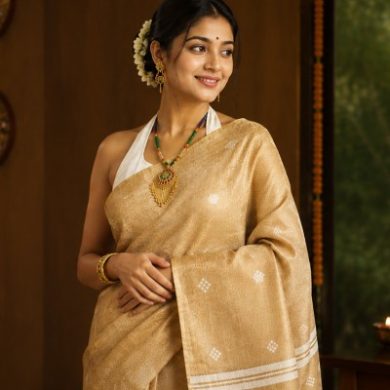
The mekhela is the bottom half, a cylindrical tube of fabric wrapped and tucked around the waist, sitting from the waist to the feet. It has no stitching on the sides, no drawstring, and no hooks. It stays put through a careful series of folds and tucks at the waistband. The sador is the upper drape, a long rectangular piece of cloth that gets tucked into the mekhela at the front and then thrown over the left shoulder. A fitted blouse called a riha traditionally goes between the two, though modern versions often swap it for a regular blouse.
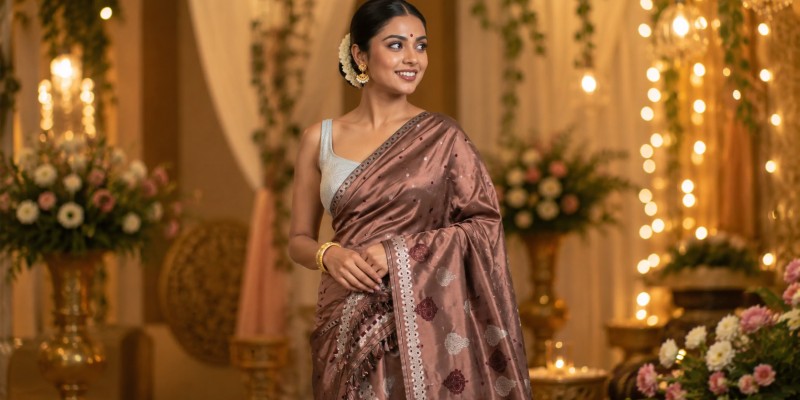
The silhouette this creates is different from a saree in a specific way. The mekhela does not have pallu falls at the back. The sador drapes at the front and over the shoulder, giving the whole ensemble a cleaner, more column-like shape. It moves beautifully and sits comfortably, which matters a lot when you are spending six hours at a wedding.
The name varies by region and spelling. You will see it written as mekhela chador, mekhla chador, mekhela sador, and a few other variants. They all refer to the same garment.

Choosing the right fabric for the occasion

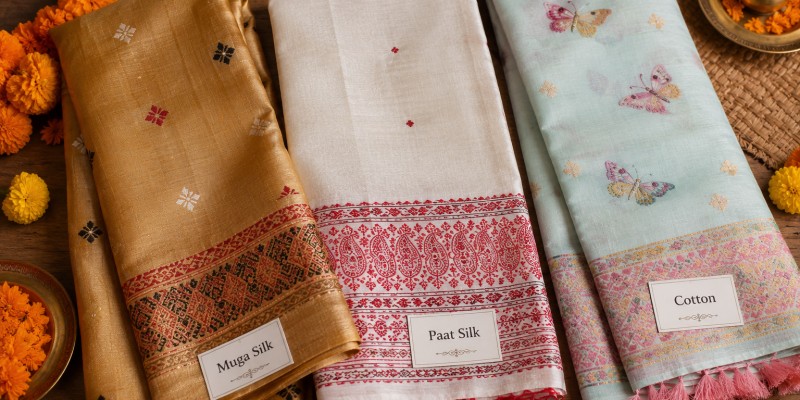
The fabric decision is where most styling mistakes happen. Mekhela sadors come in a wide range of materials, from everyday cotton to heirloom muga silk, and the occasion should drive which one you reach for.

For weddings: Paat and Muga silk

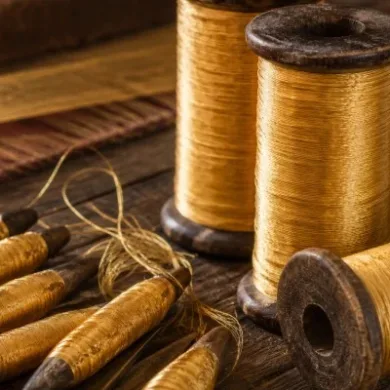
If you are attending or dressing as an Assamese bride, paat silk and muga silk are the two fabrics that belong at a wedding. Paat is Assam’s mulberry silk, typically white or cream with a luminous sheen, traditionally worn by brides in specifically auspicious sets like the Saat Gaxi bridal trousseau. Muga, the naturally golden silk discussed in more depth elsewhere on this blog, is the fabric most associated with celebrations, heirlooms, and status. A wedding mekhela sador in muga carries a weight that goes beyond aesthetics. The fabric has been part of Assamese wedding ceremonies for centuries.
For wedding guests who want a dressy option that is not quite at heirloom level, silk blends and artificially woven kinkhap-style mekhelas offer the visual richness of silk at a more accessible price. The key is that the fabric has enough body and sheen to read as formal. Lightweight cotton and daily-wear silk will look underdressed next to bridal lehengas and heavy sarees.

For festivals like Bihu: Cotton and silk-cotton blends

Bihu, especially Bohag Bihu in April, is a warm outdoor celebration. Heavy muga silk is beautiful but uncomfortable when you are dancing. Traditional Bihu mekhelas tend to use light-to-medium cotton or silk-cotton blends with bright, bold motifs. The pattern matters as much as the fabric here. Bihu mekhelas are known for their nature-inspired motifs: butterflies, peacocks, flowers, and creepers worked into the weave in contrasting thread.
Other Assamese festivals like Durga Puja and Diwali fall in cooler months, which opens up your options. Silk and heavier blends work well, and the colour choices can go darker and richer than the pastels traditionally associated with spring celebrations.

For smaller ceremonies and pujas: Eri silk and daily-wear sets
Not every occasion calls for full silk. Eri silk, the soft and warm Assamese variety often described as Ahimsa silk, strikes a balance between comfort and ceremony. It is well-suited for morning pujas, community events, and smaller family gatherings where you want to look appropriate without outshining the main occasion.

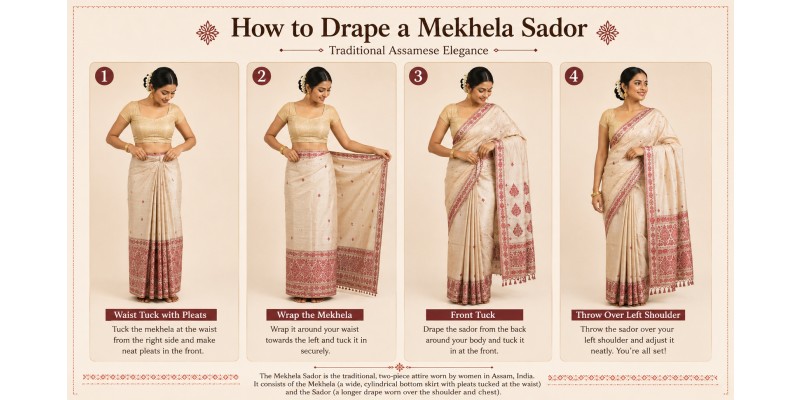
How to drape a mekhela sador: a step-by-step guide

The draping is the part people are most anxious about, and the anxiety is usually worse than the process. Mekhela sadors do not use pins or stitching. Once you understand the logic of the tucks, it holds in place well. Here is the sequence.

Step 1: Wear your blouse first

Put on your blouse before anything else. If you are wearing a traditional riha, that goes on now. Make sure it fits well and sits at the waist, because the mekhela tucks over it at the waistline.

Step 2: Step into the mekhela

The mekhela is a tube. Step into it and pull it up to your waist. Hold the open edge of the fabric in front of you with your right hand. You are going to make pleats here, roughly three to five folds of even width, and tuck them into the waistband slightly to the left of your navel. The pleats fall towards the left side.
Once the pleats are set, take the remaining fabric and wrap it once to the right, around the back, and secure it at the waist on the right side. Pull the fabric taut enough that it sits flat, but not so tight that it pulls or restricts movement. The mekhela should feel secure when you walk and slightly resistant when you try to push it down with your hands.

Step 3: Tuck in the sador at the front

Take the sador and find the end with the decorative border. This end gets tucked into the mekhela waistband at the centre front, just above the pleats. Tuck it in firmly, about five to six centimetres, so it does not slip during the day.

Step 4: Drape over the left shoulder

Now take the length of the sador across the front of your body, slightly diagonally, and throw it over your left shoulder. The decorated border should fall behind you. Let the rest of the fabric hang down the back. The traditional Assamese drape does not involve wrapping the sador around the body multiple times. It is a single diagonal fall from the waist tuck to the left shoulder.

Adjust the front so the sador falls at a flattering angle. The amount of the sador visible at the front is a matter of preference, but enough to show the border and any woven motifs is the general aim.

Step 5: Secure and adjust

Once the drape is where you want it, you can use a single safety pin at the shoulder to keep the sador in place, though many experienced wearers skip this entirely. If you plan to dance at Bihu, the pin is worth adding. For a wedding where you will be sitting and standing through ceremonies, the tuck and natural weight of the fabric usually hold everything in position.

Jewellery that belongs with a mekhela sador

The mekhela sador has its own jewellery vocabulary, and it is worth understanding before you default to whatever gold set is in your wardrobe. Assamese jewellery has a specific aesthetic: bold organic shapes, motifs drawn from nature, and gold as the almost universal metal. Layering it with the right pieces completely changes the register of the outfit.

The Jonbiri: the piece everyone recognises

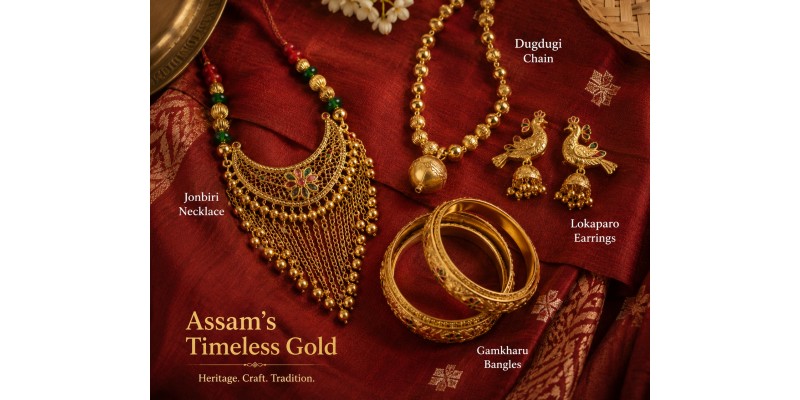
The Jonbiri is Assam’s most iconic necklace. It is a crescent-shaped pendant, often set with a central coral or semi-precious stone, worn at the base of the throat. When you see a woman in a mekhela sador in any official photograph or festival coverage, the Jonbiri is almost certainly the necklace she is wearing. It is the equivalent of what a pearl set is to a kanjivaram saree.

Dugdugi and Bana: layering necklaces

The Dugdugi is a longer chain necklace worn below the Jonbiri, creating a layered effect at the chest. The Bana is a coin-style necklace with several coins or medallions suspended on a chain. Wearing all three layered is traditional formal dress. For a more modern take, just the Jonbiri with stud earrings reads as elegant without being overwhelming.

Keru, Lokaparo, and Gamkharu: completing the look

Ear jewellery includes the Keru, large circular earrings with intricate gold work, and the Lokaparo, earrings shaped like birds. For the wrists, Gamkharu bangles, thick gold bangles with distinctive ridged patterns, are the traditional choice. These are not interchangeable terms for the same thing. Each piece has a specific place in the traditional Assamese jewellery set, and wearing all of them together for a wedding is completely appropriate.

If you are looking for authentic Assamese jewellery to pair with your mekhela sador, Ethnohues carries traditional pieces sourced directly from Assam, including the Jonbiri, Gamkharu, and Lokaparo styles that complete Handwoven Assam Silk Sarees & Jewellery ensembles properly.
Getting the colours and blouse pairing right

Colour coordination for a mekhela sador follows different rules from saree styling, because the three separate pieces, mekhela, sador, and blouse, give you more combination points to play with.

Traditional colour logic

Traditionally, the mekhela and sador are woven in the same fabric as a matched set, and many contemporary sets still follow this. The contrast comes from the blouse, which is typically chosen in a colour that either matches the border of the sador or provides a complementary contrast to the main fabric colour.

For gold muga, a deep red, forest green, or burgundy blouse is a classic pairing. For white paat silk, red is traditional and almost always correct. For cotton festival sets in bright colours, a matching or slightly darker blouse in the same colour family keeps the look coherent.

Modern approaches that still work

Contemporary Assamese styling has loosened up these rules considerably without losing the look. Pastel blouses with heavy silk mekhela sadors create a lighter, more modern effect. Embroidered or worked blouses in contrast colours have become popular at weddings, treating the blouse almost as a statement piece. The one rule that almost everyone sticks to: avoid clashing prints. If the mekhela has a busy woven motif, the blouse should be solid or very subtle.

Assamese bridal wear colour traditions

For Assamese bridal wear, the colour conversation gets more specific. Traditionally, Assamese brides wear a combination called Paat mekhela in white or cream with a red border for the actual wedding ceremony. Muga with its natural gold colour is also widely considered auspicious and is used extensively in pre-wedding rituals and at the wedding feast. Red and white together hold specific sacred significance in Assamese tradition. Contemporary brides sometimes wear heavily embroidered or zari-worked versions, but the foundational colour combination tends to stay close to these roots.

Hair and makeup that complete the mekhela sador look

The outfit does most of the work. Hair and makeup are about not undermining it.

Hair for weddings

The most traditional bridal hair for a mekhela sador is a low bun decorated with fresh flowers, typically white kaan phool or marigolds, and secured with a gold hair ornament. This creates a clean silhouette that does not compete with the Keru or Lokaparo earrings. Modern brides have moved toward loose waves, half-up styles, and braided updos, all of which work, but the flower decoration is worth keeping because it ties visually to the natural motifs in the fabric.

Hair for Bihu and festivals

Bihu has its own traditional look: a high bun with fresh flowers, often the pekok phool or other local blooms, paired with the red tikori bindi on the forehead. This is an active celebration, so elaborate hair tends to work against you. A secure bun with flowers hits the traditional note without falling apart during the Bihu dance.

Makeup

Assamese traditional makeup is actually quite minimal. A defined brow, a bit of kajal, and a red bindi are the traditional elements, and they hold up well at both weddings and festivals. Contemporary styling layers more onto this base, full foundation, contoured cheeks, bold lip, all of which photograph beautifully against the rich silk fabrics. The only thing to avoid is makeup so heavy that it stops reading as Assamese entirely. The outfit has cultural weight. The face should feel connected to it.

Draping variations: traditional versus contemporary

There is more than one way to drape the sador, and the variation you choose sends a signal about the formality of the occasion.

The traditional single-shoulder drape

This is the method described in the step-by-step section above. One tuck at the waist, one throw over the left shoulder. It is the correct drape for weddings, pujas, and any occasion where the mekhela sador is worn in its most culturally authentic form. If in doubt, use this one.

The modern front-draped style

Some contemporary wearers, especially at fashion events and styled shoots, drape the sador across the front body and pin it at the right shoulder instead of the left, creating a different diagonal. This is not traditional and it would not be appropriate at a religious ceremony, but it photographs differently and has become popular in Assamese fashion content. Know the context before choosing it.

The half-sador style for casual festivals

For very casual community celebrations or daytime Bihu events, some women drape the sador shorter, tucking more of it into the waistband so less fabric hangs behind. This creates a more practical length for dancing. It is a minor variation but worth knowing if you find the full-length sador getting in your way on an energetic day.

What to look for when buying a mekhela sador

If you are buying one for the first time, or buying a special occasion set, these are the things that matter.
  • Fabric authenticity. If it is labelled muga or paat silk, ask where it came from. Genuine Assam silk comes from registered weavers in the state. There are many synthetic look-alikes at lower price points. They look fine in photographs but feel entirely different and do not carry the durability of real silk.
  • Motif quality. The woven motifs in an authentic mekhela sador are worked on the loom using a technique that takes time. The motifs on the border and body should be crisp, slightly raised on the reverse side, and consistent across the fabric length. Printed or embroidered imitations flatten these details.
  • Length. The sador should be long enough to drape comfortably over your shoulder with enough fabric to fall down your back. Standard lengths work for most heights, but if you are particularly tall, ask about extended-length sets before buying online.
  • Sourcing. The mekhela sador market is full of mass-produced pieces passed off as handwoven. Buying directly from a seller who works with Assamese weavers is the clearest way to get what you are paying for.
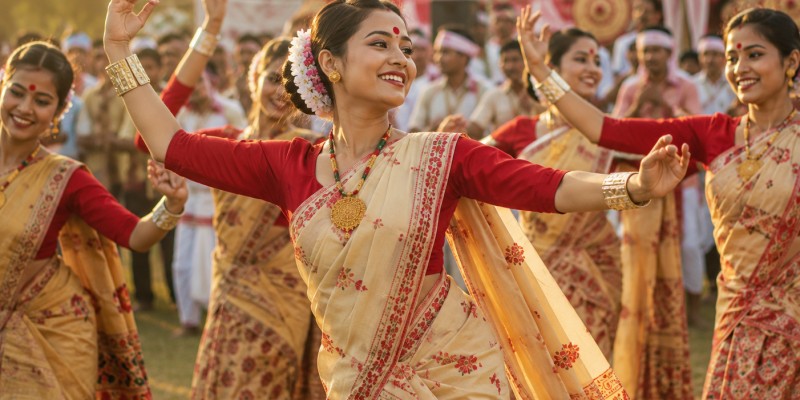
Ethnohues sources all its mekhela sadors and silk pieces directly from master weavers in Assam. The collection at ethnohues.com includes muga and paat silk sets, eri pieces, and matching jewellery, all with clear provenance. If you are building a wardrobe of authentic Assamese textiles rather than buying one piece and being done with it, that kind of sourcing transparency makes a real difference.

One last thought

The mekhela sador is not a difficult garment to wear well. The draping takes a few tries to feel natural, the jewellery has a learning curve, and choosing the right fabric for the right occasion takes some knowledge. But none of it is inaccessible. And once you get comfortable with the two-piece logic of the ensemble, you will probably find it more wearable than most of what hangs in your wardrobe.
If you are wearing one to a wedding or festival for the first time, practise the drape at home at least once the day before. Wear it around the house for an hour. Sit down, stand up, walk across a room. You will find the tuck that holds and the one that does not, and you will be infinitely calmer by the time the actual occasion arrives.
The rest is just showing up in something that has been made with care, worn with intention, and carries a few centuries of Assamese tradition with it.
What is Muga Silk? Everything ...

Related posts

image2
Blog
Read more

What is Muga Silk? Everything You Need to Know About Assam’s Golden Silk

July 13, 2026 0
There is a silk in the world that gets more beautiful the more you use it. That... Continue reading
Ethnohues Assamese handloom and traditional jewellery
Blog
Read more

Terracotta Jewellery: What It Is, How It’s Made, and Why It’s Back in Style

April 16, 2026 0
Fashion trends come and go, but some traditions always return to the spotlight. Terracotta jewellery is one of these,... Continue reading
Ethnohues Assamese handloom and traditional jewellery
Blog
Read more

What Is Trending in Ethnic Wear in 2025: A Complete Style Guide

February 11, 2026
Ethnic fashion in India has always been a gorgeous fusion of culture, handicraft, and creativity... Continue reading

Add comment Cancel reply

Your email address will not be published. Required fields are marked

Ethnohues logo

Newsletter

Subcribe to get information about products and coupons


    • Quick Links

      • Sador Mekhela

      • Saree

      • Stoles

      • Assam Ethnic Jewellery

      • Terracotta Jewellery

      • Exclusive Products

    • Business

      • Privacy Policy

      • Terms & Conditions

      • Careers

      • Blogs

    • +91 7892516379
    • contact@ethnohues.com
    Facebook Instagram
    EthnoHues: The Destination for Authentic Muga Silk Sarees 
    Specializing in pure Assamese handloom, EthnoHues brings the world-renowned Muga silk saree directly from the heart of Assam to your home. Our collection is defined by its signature golden lustre and artisanal craftsmanship, ensuring you receive a premium, pure Muga silk saree that honours traditional weaving while exuding timeless sophistication.
    Authentic Assamese Attire: Pator & Pat Mekhela Sador
    Discover a comprehensive collection of Assamese attire, from festive white Mekhela Sadors to exquisite Pator Mekhela Sadors for weddings. We specialize in authentic Pat and Kesa Pat Mekhela Sadors, each hand-woven with traditional Junbiri patterns. These pieces are designed to be cultural landmarks in your ethnic wardrobe, ensuring total authenticity. Premium Handloom: Pat Silk, Eri Silk, and Beyond
    EthnoHues is your trusted source for premium Pat silk, luxurious Paat creations, and soft Eri silk sarees across India. By prioritizing a design-first approach, we ensure that every Muga Mekhela and Pat silk saree is a masterpiece of textile heritage. Shop the finest Paat Mekhela Sadors at competitive and original Muga silk saree prices.
    Developed and Designed by BUD
    WhatsApp chat
    WhatsApp chat